Ultrasound-Guided Core Needle Biopsy (CNB)
What is CT-Guided Core Needle Biopsy (CNB)?
CT-Guided Core Needle Biopsy (CNB) is a minimally invasive diagnostic procedure that uses images obtained through computed tomography (CT) to guide the insertion of a fine needle into a specific lesion or area of the body. This procedure allows for obtaining tissue samples for laboratory analysis.
What is this procedure used for?
CT-Guided CNB is used for:
- Diagnosing suspicious lesions: Allows for determining if a lesion is benign or malignant.
- Obtaining samples from deep tissues: It is especially useful for biopsies of internal organs such as the lungs, liver, kidneys, bones, among others.
- Guiding treatment: Helps doctors plan specific treatments based on the type of tissue analyzed.
Benefits of high technology in CT-Guided CNB
The procedure combines real-time CT images with the precision of a fine needle to access the target lesion. The images allow the doctor to locate the lesion and guide the needle accurately, minimizing the risk of damaging nearby structures.
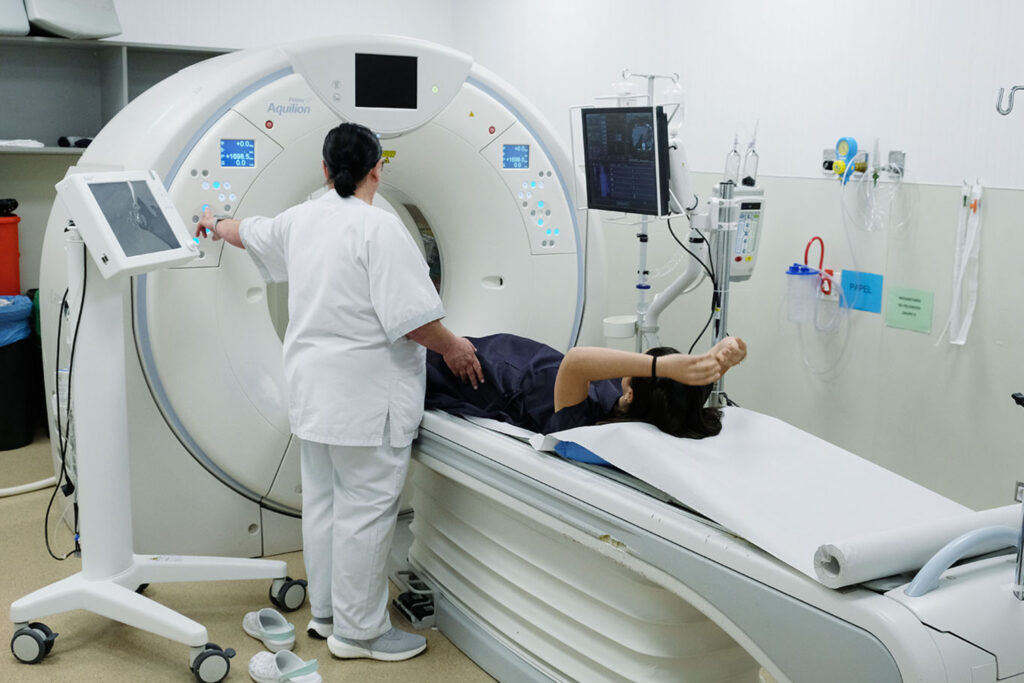
How is the procedure performed?
The CT-Guided CNB procedure involves:
-
Preparation:
Inform your doctor if you are taking anticoagulants or if you have any allergies to local anesthetics or to the materials used during the procedure. In some cases, you may need to fast before the exam, so it is important to consult with your doctor to find out if it is necessary. Additionally, it is recommended to wear comfortable, easy-to-remove clothing, as you will be provided with a hospital gown for the procedure.
-
During the test:
To perform the procedure, you will be asked to lie on the CT scanner table in a position that allows easy access to the lesion. First, initial images will be taken to precisely locate the area to be treated. Then, local anesthesia will be applied to the area where the needle will be inserted to minimize discomfort. With the guidance of real-time CT images, the doctor will carefully insert the needle until it reaches the lesion. Once in the correct position, a small tissue or fluid sample will be extracted for analysis. The procedure usually lasts between 30 and 60 minutes.
-
After the test:
After the procedure, pressure will be applied to the puncture site to stop bleeding, and a bandage will be placed. You may feel mild discomfort in the area, but it usually subsides within a few hours. For the first 24 hours, avoid strenuous physical activities. If you notice fever, redness, swelling, or persistent pain in the puncture area, notify your doctor immediately.
Recommendations for the test
- Avoid movement: During the procedure, it is important to remain as still as possible to ensure the accuracy of the biopsy.
- Follow medical instructions: Follow your doctor’s instructions before, during, and after the procedure.
Are there any risks?
CT-Guided CNB is a safe procedure, but there are some risks:
- Mild pain: You may feel pain or discomfort at the puncture site after the procedure.
- Bleeding: There is a small risk of bleeding at the puncture site.
- Infection: Although rare, there is a possibility of infection at the puncture site.
- Pneumothorax (in lung biopsies): In procedures performed on the lungs, there is a low risk of pneumothorax (partial lung collapse).
For your test to proceed smoothly, we ask that you arrive in advance of your scheduled time. This will allow us to complete the necessary administrative and clinical preparation.
Before the test, we will provide you with the Informed Consent form, a document with important information that you must read and sign.
These diagnostic tests are very safe, but as with any medical procedure, there is a minimal possibility of incidence.