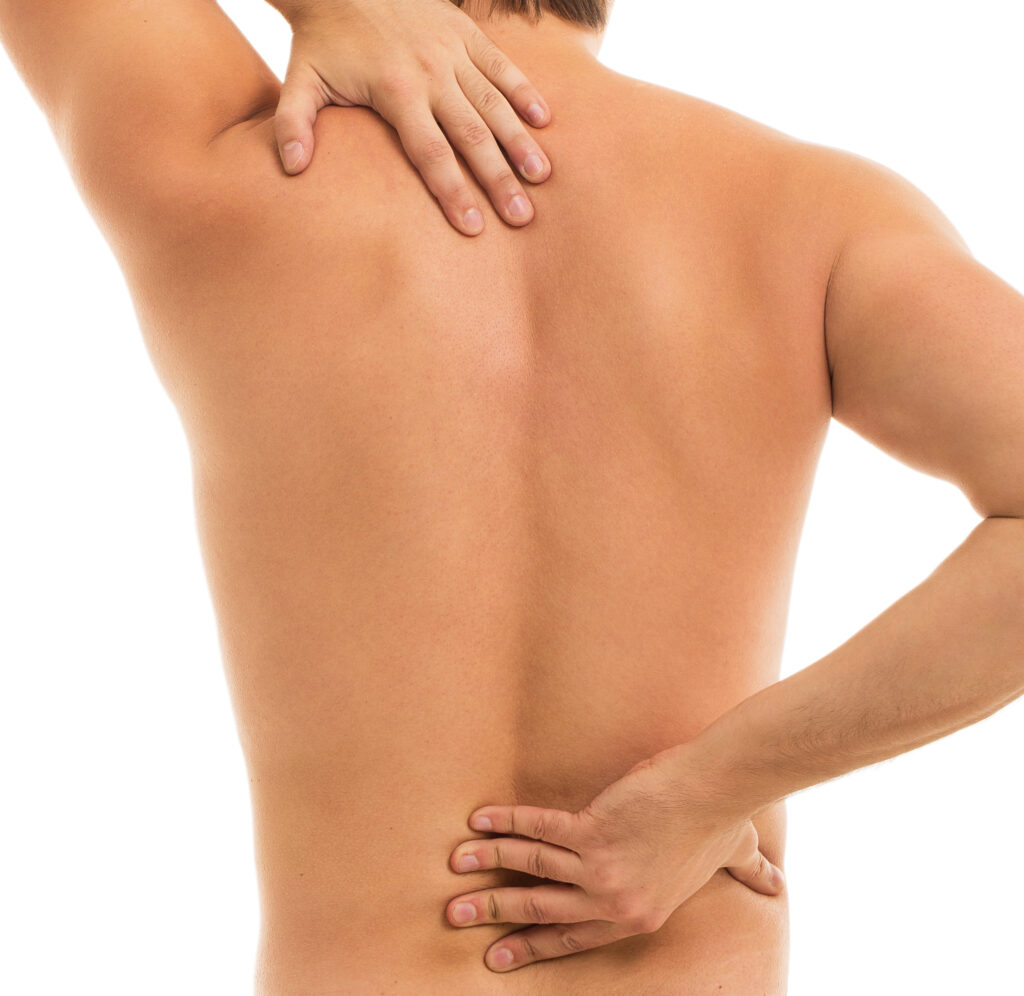
Scoliosis is an abnormal curvature of the spine. Instead of being straight, the spine of a person with scoliosis has a lateral curvature in the shape of an “S” or a “C”. This deviation can occur anywhere in the spine, but it is most common in the thoracic (upper back) and lumbar (lower back) areas. Although scoliosis can develop at any age, it is most common during adolescence, during the growth period.
Symptoms of scoliosis
The symptoms of scoliosis can vary depending on the severity of the curvature. In some cases, scoliosis is mild and does not present noticeable symptoms. However, in more severe cases, symptoms may include:
Uneven shoulders:
one shoulder may be higher than the other.
Prominent shoulder blades:
one shoulder blade may protrude more than the other.
Uneven waist:
one side of the waist may appear higher than the other.
Tilting of the body to one side.
Back pain:
although it is not always present, it can be a symptom in more severe cases.
Shortness of breath:
in very severe cases, the curvature can affect lung capacity.
Classification of scoliosis
Scoliosis can be classified using different criteria, allowing medical professionals to categorize and better understand each patient’s specific condition. The most common classifications are outlined below:
According to the age of onset:
Infantile scoliosis: it is diagnosed before the age of 3. It is usually more complex and requires close monitoring due to the potential for progression during growth.
Juvenile scoliosis: it is diagnosed between the ages of 4 and 10. Like infantile scoliosis, it has a higher risk of progression.
Adolescent scoliosis: the most common type is diagnosed after age 10, usually during the accelerated growth period of puberty.
According to the cause:
Idiopathic scoliosis: it represents the vast majority of cases and its cause is unknown. It is subdivided into infantile, juvenile, and adolescent, according to the age of onset.
Congenital scoliosis: it is due to vertebral malformations present at birth. These malformations may include hemivertebrae (incomplete vertebrae), fused vertebrae, or unilateral bars (abnormal unions between vertebrae).
Neuromuscular scoliosis: associated with neuromuscular diseases, such as muscular dystrophy, cerebral palsy, or poliomyelitis. Muscle weakness and lack of postural control contribute to spinal deformity.
Syndromic scoliosis: it is part of a broader genetic syndrome, such as Marfan syndrome, Down syndrome, or neurofibromatosis.
Depending on the location of the curve:
Thoracic scoliosis: the curve is located in the thoracic region (upper back).
Lumbar scoliosis: the curve is located in the lumbar region (lower back).
Thoracolumbar scoliosis: the curve encompasses both regions, thoracic and lumbar.
According to the shape of the curve:
C-shaped scoliosis: the spine has a single lateral curve.
S-shaped scoliosis: the spine has two lateral curves in opposite directions.
Causes of scoliosis
The causes of scoliosis vary depending on the type. In most cases (idiopathic scoliosis), the cause of scoliosis is unknown. Genetic and environmental factors are believed to be involved, but the evidence is still limited.
There are other types of scoliosis with a different origin, such as congenital (present at birth), neuromuscular (associated with neuromuscular diseases), and degenerative (due to wear and tear of the spine with age). la degenerativa (debido al desgaste de la columna con la edad).
While the exact cause of scoliosis is often unknown, especially in the case of idiopathic scoliosis, certain factors have been identified that may increase the likelihood of developing this condition or influence its progression. These risk factors do not guarantee that a person will develop scoliosis, but they increase susceptibility. Below are some of the most common risk factors associated with scoliosis:
Age: idiopathic scoliosis usually develops during adolescence.
Sex: girls are at greater risk of developing scoliosis than boys.
Family history: having a family member with scoliosis increases the risk.
Rapid growth: periods of accelerated growth, such as puberty, can increase the risk of curve progression in people with scoliosis.
Complications of scoliosis
While most cases of scoliosis are mild and do not cause significant problems, more severe curves can lead to a number of complications, including:
Respiratory problems: in cases of severe scoliosis, the curvature of the spine can compress the lungs, making breathing difficult and reducing lung capacity. This can increase the risk of respiratory infections and affect exercise tolerance.
Heart problems: in very severe cases, scoliosis can affect heart function by compressing the heart.
Back pain: back pain is a common complication of scoliosis, especially in adults. Abnormal curvature of the spine can put pressure on the muscles, ligaments, and joints of the back, causing chronic pain.
Neurological problems: in some cases, scoliosis can compress the nerves in the spine, causing pain, numbness, tingling, or weakness in the legs.
Aesthetic deformity: scoliosis can cause a visible deformity in the back, with uneven shoulders, prominent shoulder blades, and a tilt of the body to one side. This can affect the patient’s self-esteem and body image.
Complex regional pain syndrome: in rare cases, scoliosis surgery can trigger complex regional pain syndrome, a chronic condition that causes intense and persistent pain.
Psychological problems: living with scoliosis, especially in more visible cases, can affect the patient’s self-esteem and confidence, leading to problems with anxiety or depression.
It is important to note that the likelihood of developing these complications is higher in cases of severe and untreated scoliosis, so early diagnosis and treatment are essential to prevent the progression of the curvature and minimize these complications. A multidisciplinary approach involving traumatologists, physiotherapists, and appropriate treatment can help improve posture, reduce pain, and improve the patient’s quality of life.
Diagnosis of scoliosis
The diagnosis of scoliosis is based on a comprehensive evaluation that includes:
Physical examination:
Posture observation: the doctor will examine the patient’s back for asymmetries, such as uneven shoulders, a more prominent shoulder blade, or a higher hip.
Forward bend test (Adams test): this test is performed with the patient leaning forward from the waist. It allows the detection of a rib hump, which is a prominence on the back caused by the rotation of the vertebrae.
Spinal alignment assessment: the doctor will feel the spine to detect lateral deviations.
Leg length measurement: it is performed to rule out discrepancies in leg length, which can cause an apparent curvature of the spine.
Magnetic resonance imaging (MRI) or computed tomography (CT): in some cases, these tests may be ordered to rule out other conditions, such as tumors or infections, or to evaluate the spinal cord for abnormalities.
X-rays: X-rays of the spine are essential to confirm the diagnosis of scoliosis and to measure the Cobb angle, which quantifies the magnitude of the curvature. They also allow for the assessment of vertebral rotation and skeletal maturity.
Scoliosis treatment
Scoliosis treatment is tailored to each patient, taking into account the severity of the curvature, age, growth potential, and underlying cause.
Observation: for mild curvatures (Cobb angle less than 25 degrees), regular follow-up with X-rays is performed to monitor progression. The frequency of follow-up depends on the patient’s age and the risk of progression.
Exercises: physiotherapy plays an important role in the conservative treatment of scoliosis. Specific exercises can help strengthen the back muscles, improve posture, increase flexibility, and, in some cases, slow the progression of the curve. At HM Hospitales, we offer personalized physiotherapy programs for each patient.
Brace (orthosis): for moderate curvatures (Cobb angle between 25 and 45 degrees) in patients who are still growing, a brace can be used to prevent the curve from worsening. There are different types of braces, and the choice of the most suitable one depends on the type and location of the curve. The brace should be worn for a specific number of hours per day, as directed by the doctor.
Pharmacological treatment: it focuses on relieving pain associated with scoliosis. Pain relievers, nonsteroidal anti-inflammatory drugs (NSAIDs), or muscle relaxants may be used.
Surgical treatment: surgery is considered for severe curvatures (Cobb angle greater than 45 degrees) or progressive curvatures that do not respond to conservative treatment. The main goal of the surgery is to correct the curvature, stabilize the spine, and prevent future complications. Spinal fusion is the most common surgical procedure for scoliosis. It involves correcting the curvature and fusing the affected vertebrae using bone grafts and instrumentation (rods, screws, hooks). At HM Hospitales, we have specialists in Robotic Surgery, which allows for greater precision and faster recovery. https://www.hmhospitales.com/cirugia-robotica/There are different approaches to spinal fusion: posterior, anterior, or combined.
The choice of approach depends on the location and type of curve, as well as the surgeon’s experience. At HM Hospitales, we have a spine unit comprised of neurosurgeons and traumatologists specializing in the spine, among other medical professionals.
Remember that this article is for informational purposes only and does not replace professional medical advice. If you suspect you have scoliosis, consult a specialist to obtain an accurate diagnosis and an appropriate treatment plan tailored to your needs.
Our doctors
Contact and make an appointment with the professionals in this area