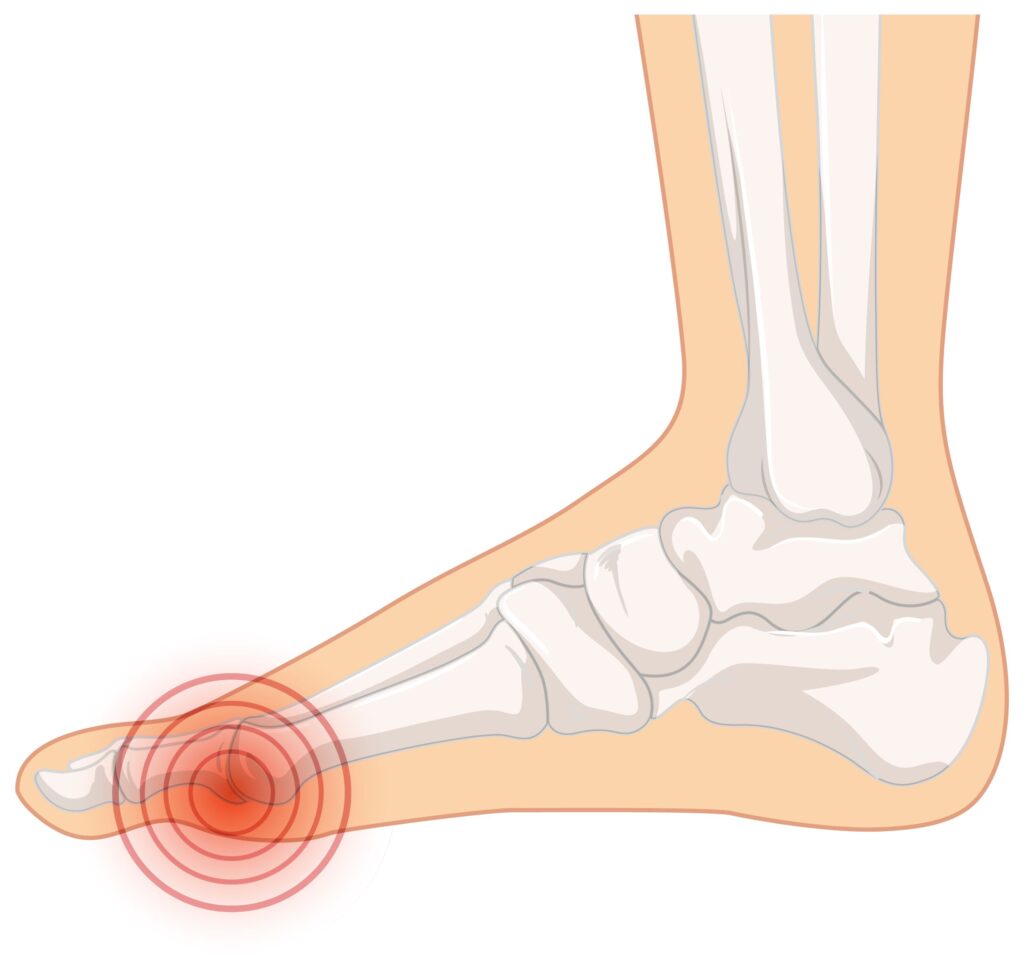
Bunions, or Hallux Valgus, are a complex foot deformity that affects the metatarsophalangeal joint of the big toe. This joint is the one that joins the first metatarsal (long bone of the foot) with the proximal phalanx of the big toe. In Hallux Valgus, the big toe deviates towards the second toe, while the first metatarsal deviates in the opposite direction. This misalignment creates the characteristic bony bump on the inside of the foot, which is known as a bunion.
Symptoms of bunions
The symptoms of Hallux Valgus can range from mild to severe, depending on the degree of deformity and the presence of inflammation.
Initial:
in the initial stages, Hallux Valgus can cause mild pain or discomfort in the big toe joint, especially when wearing tight shoes. The bunion area may be swollen and reddened, and a small bony bump may be palpable.
Advanced:
as the deformity progresses, the deviation of the big toe becomes more pronounced and may even overlap the other toes. The bunion increases in size, causing intense pain, even at rest. Walking becomes difficult, and finding suitable footwear is a challenge. Calluses or hardened skin may appear in the affected area, and deformities may also develop in other toes, such as hammer toes or claw toes.
Classification of bunions
Hallux Valgus classification is essential for determining the most appropriate treatment. Different methods are used, including clinical evaluation and X-rays. Using X-rays, the angle of deviation of the big toe and the first metatarsal is measured. Generally, a deviation of the big toe of 10–20 degrees is considered mild, 20–40 degrees is considered moderate, and more than 40 degrees is considered severe. The presence and degree of osteoarthritis in the joint are also evaluated. Some classification systems, such as the Manchester system, combine angulation with the presence of symptoms and joint congruity.
Causes and risk factors of bunions
Hallux Valgus is a multifactorial condition. While the exact cause is not fully known, it is believed that a combination of genetic, biomechanical, and environmental factors, such as the use of inappropriate footwear, contribute to its development.
There are certain factors that can increase the likelihood of developing Hallux Valgus.
Genetics: family predisposition plays an important role. If you have family members with bunions, you are more likely to develop them.
Sex: women are significantly more likely to develop bunions than men, possibly due to hormonal factors and the type of footwear they usually wear.
Inappropriate footwear: prolonged use of narrow, high-heeled shoes compresses the toes and forces the big toe into an incorrect position, which increases the risk of developing bunions.
Flatfoot: the lack of an arch in the foot alters weight distribution and foot biomechanics, increasing the risk of Hallux Valgus.
Inflammatory diseases: conditions such as rheumatoid arthritis can weaken joints and contribute to the development of bunions.
Injuries: foot injuries can damage the big toe joint and cause a predisposition to the formation of bunions.
If it is not treated, Hallux Valgus can lead to various complications, including:
Bursitis: inflammation of the bursa, a small fluid-filled sac that cushions the joint, can cause pain and swelling.
Metatarsalgia: pain in the sole of the foot, under the base of the toes, is a common complication of Hallux Valgus.
Hammer toes or claw toes: deviation of the big toe can affect the alignment of the other toes, causing deformities such as hammer toes or claw toes.
Difficulty walking: pain and deformity can limit mobility and make walking difficult.
Infections: in severe cases, the bunion can become infected, requiring medical treatment.
Diagnosis of bunions
The diagnosis of Hallux Valgus is based on clinical evaluation and imaging tests.
Physical examination: it includes observation of the deformity, palpation of the joint, and assessment of the range of motion.
Imaging tests: weight-bearing X-rays are essential to confirm the diagnosis, determine the angle of deviation of the big toe, assess the presence of osteoarthritis and rule out other conditions. Other imaging tests, such as magnetic resonance imaging or computed tomography, may also be used in specific cases.
Bunion treatments
The treatment of Hallux Valgus should be individualized according to the severity of the symptoms and the degree of deformity. Among the different treatment options are:
Conservative treatments: they are used in mild or moderate cases and aim to relieve symptoms and stop the progression of the deformity. This includes changes in footwear, the use of insoles, medications (mainly painkillers to relieve pain) and physiotherapy. It is essential to wear wide, comfortable shoes with a wide toe box that do not compress the toes. High heels and pointed shoes should be avoided. In turn, custom-made insoles, adapted to the shape of the foot, help to correct the biomechanics of the foot, distribute weight evenly and reduce pressure on the bunion. Finally, physiotherapy can be helpful for strengthening the foot muscles, improving flexibility and the range of motion of the big toe, and relieving pain.
Surgical treatment: surgery is considered when conservative treatments have failed to relieve symptoms or when the deformity is severe. The most common techniques include osteotomies (cuts in the bone to correct the deformity), arthrodesis (fusion of different bones), and exostectomy (resection of the bump or bunion). Minimally invasive surgery is an option in some cases. The type of surgery is chosen based on the severity of the deformity, the patient’s age, and their overall health. Often, the entire forefoot needs to be addressed, rather than the bunion in isolation, to avoid complications.
Remember that this article is for informational purposes only and does not replace professional medical advice. If you suspect you have bunions, consult a specialist to obtain an accurate diagnosis and an appropriate treatment plan tailored to your needs.
Our doctors
Contact and make an appointment with the professionals in this area