MRI with specific software
What is MRI with specific software?
Magnetic resonance imaging (MRI) with specific software refers to the use of specialized computer programs that complement the acquisition of MRI images to improve diagnosis, treatment planning, and monitoring of various diseases. These programs allow for more detailed analysis of images, quantification of different parameters, and more precise visualization of anatomical structures.
What is this diagnostic procedure for?
MRI with specific software is used for a wide variety of purposes, including:
- Improved diagnosis: it enables the detection of subtle lesions that might go unnoticed in conventional MRI images.
- Parameter quantification: it allows for the quantification of different parameters, such as the volume of a structure, signal intensity, or blood flow, providing objective information for diagnosis and disease monitoring.
- Treatment planning: It helps plan treatments, providing detailed information about the anatomy and extent of the disease.
- Monitoring the response to treatment: it allows the response to treatment to be monitored by evaluating changes in the quantified parameters over time.
- Research: it is used in research to study the functioning of the brain and other parts of the body.
Benefits of advanced technology in an MRI with specific software
An MRI with specific software offers a number of key benefits thanks to the technology it uses:
- Greater diagnostic accuracy: it allows for a more accurate and earlier diagnosis of various diseases.
- Objective information: it provides objective and quantifiable information that can be used to monitor disease progression and response to treatment.
- Treatment personalization: it facilitates the personalization of treatment, allowing the treatment to be adapted to the individual characteristics of each patient.
Improvement in quality of life: it can improve the quality of life of our patients by allowing for earlier diagnosis and more effective treatment.
What does the procedure involve?
The MRI with specific software procedure is similar to that of a conventional MRI:
-
Preparation:
You will be asked to remove all metal objects (jewelry, piercings, etc.) from your body. It is important to inform your doctor if you have metal implants in your body, such as pacemakers or cochlear implants.
-
During the procedure:
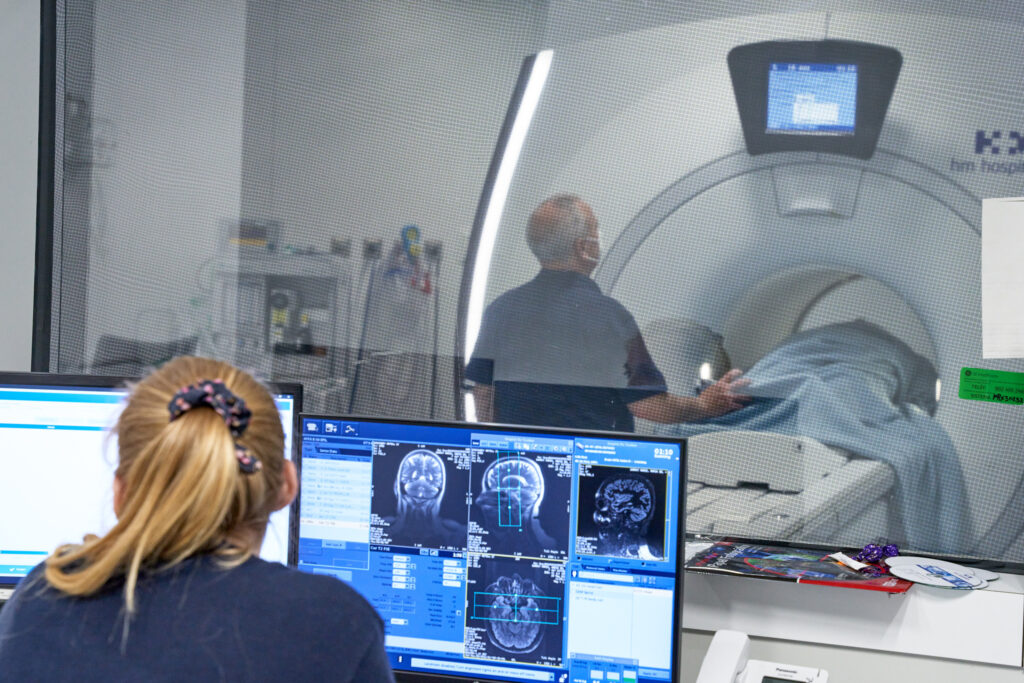
You will lie down on a table that slides into the MRI scanner. A coil will be placed on your head or on the area of your body that will be examined. You will be asked to remain still while the images are taken. In some cases, an intravenous contrast agent may be administered to improve visualization of the anatomical structures.
-
After the procedure:
You can resume your normal activities immediately after the procedure.
The main difference from a conventional MRI is that the acquired images will subsequently be processed with specific software to obtain additional information.
Recommendations for the procedure
Remember that it is important to adhere to the following recommendations to ensure the quality of the test and your comfort:
- Inform about metal implants: it is crucial to inform the medical team if you have metal implants in your body, such as pacemakers or cochlear implants.
- Remain still: it is important that you remain still while the images are taken to avoid blurry images.
- Follow instructions: carefully follow the instructions provided by the MRI technician.
Are there any risks?
An MRI with specific software is generally considered safe, but like any medical procedure, there are some minor risks to consider:
- Claustrophobia: some people may experience claustrophobia while inside the MRI scanner.
- Noise: the MRI scanner makes a loud noise that may be bothersome for some people. You will be provided with earplugs or headphones to reduce the noise.
- Allergic reactions: in rare cases, allergic reactions to the contrast agent used in some MRI scans may occur.
To ensure your procedure runs smoothly, we ask that you arrive before the scheduled time. This will allow us to complete the necessary administrative and clinical preparation.
Before the procedure, we will give you the Informed Consent form, a document with important information that you must read and sign.
If your appointment is for an MRI, it is crucial that you inform us about the presence of pacemakers, metallic objects, prostheses (including dental prostheses), tattoos, or drug infusion devices such as insulin pumps.
These diagnostic tests are very safe, but as with any medical procedure, there is still the unlikely possibility of an incident.
Do you need to undergo this procedure?
Make an appointment