Cardiac MRI
What is a cardiac MRI?
Cardiac Magnetic Resonance Imaging (cardiac MRI) is an advanced diagnostic imaging study that allows for a detailed evaluation of the structure, function, and circulation of the heart and blood vessels. It is a non-invasive tool that does not use radiation.
A cardiac MRI is ideal for studying soft tissues such as the heart muscle or valves. It provides three-dimensional images and allows you to see the heart in motion, making it a very accurate technique for diagnosing various heart diseases.
What is a cardiac MRI used for?
A cardiac MRI is used for:
- Analyzing the size and function of the heart chambers.
- Detecting damage to the heart muscle after a heart attack.
- Evaluating congenital heart defects.
- Diagnosing inflammation of the heart (myocarditis).
- Identifying cardiac tumors or masses.
- Assessing problems with the heart valves.
- Detecting fibrosis or scarring in heart tissue.
- Evaluating diseases such as ischemic heart disease, cardiomyopathies, or pericarditis.
How does advanced technology work in a cardiac MRI?
Cardiac MRI is an advanced technique that obtains detailed images of the heart and its structures without the need for surgery or exposure to radiation. To achieve this, it uses:
- Powerful magnetic fields: a high-intensity magnet (between 1.5 and 3 Tesla) aligns the water protons in the body, allowing clear images of the heart to be generated.
- Radiofrequency (RF) waves: these waves cause the protons to vibrate and, when they return to their original state, they emit signals that the machine translates into detailed images.
- Synchronization with the heartbeat: during the study, an electrocardiogram (ECG) records the heartbeats to capture images at key moments, allowing observation of the heart in motion and detection of possible abnormalities.
- Gadolinium contrast (optional): in some cases, a special contrast agent is injected to better visualize blood vessels and areas of the heart muscle that may be damaged.
Artificial intelligence and advanced software: some modern equipment incorporates AI to improve image quality and reduce study time, making the process more efficient.
What does the procedure involve?
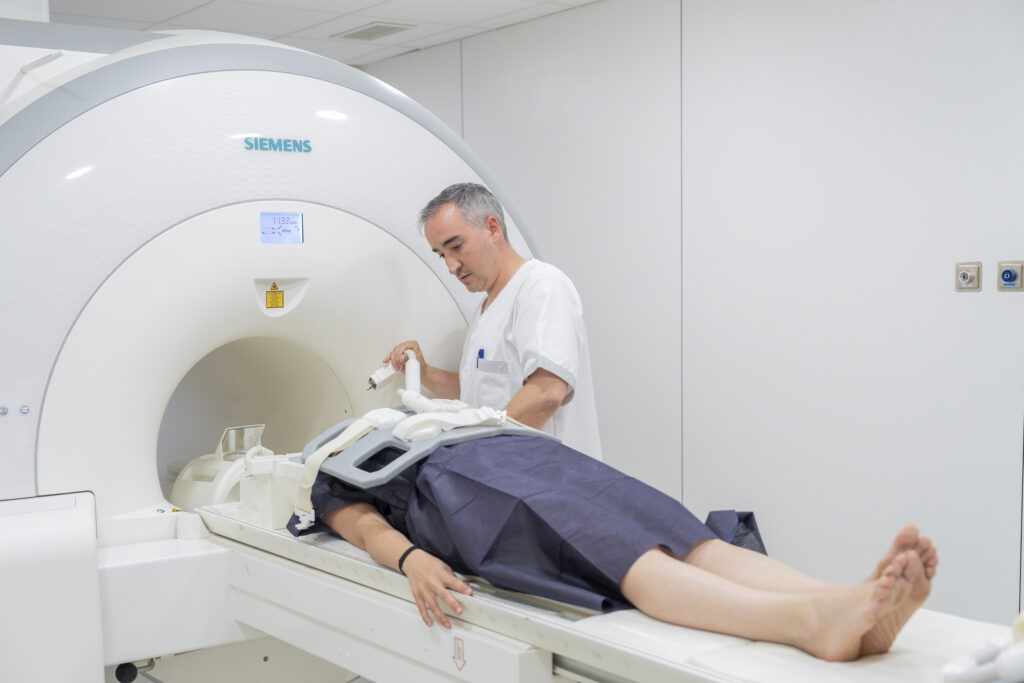
A cardiac MRI is a simple, non-invasive, and safe procedure that allows for obtaining detailed images of the heart. Below, we explain step by step how it is done:
-
Preparation:
Before the procedure, it is important to follow some recommendations. If contrast is going to be used, your doctor may tell you not to eat or drink for 4 to 6 hours before the exam. You should also remove any metal objects such as jewelry, watches, or piercings, as these can interfere with the operation of the MRI.
If you have a pacemaker, metal prostheses, or other implants, be sure to inform the medical staff so they can take the necessary precautions. In some cases, gadolinium, an intravenous contrast agent that helps to highlight images of the heart and blood vessels, will be used.
-
During the procedure:
When you’re ready, you’ll lie on your back on a table that slides into the MRI machine. During the procedure, small electrodes will be placed on your chest to monitor your heart rate and synchronize the images with your heartbeat.
The MRI machine makes loud noises while taking the images, so the medical team will provide you with earplugs or headphones. It is also important that you follow the technician’s instructions on when to hold your breath momentarily, as this improves the quality of the images of your heart in motion.
-
Upon completion:
Once the scan is over, the electrodes will be removed and, if contrast was used, the intravenous line will be removed. The procedure usually lasts between 30 and 60 minutes, and afterward you can resume your normal daily activities. If it was necessary to use contrast, it is recommended that you drink water to help eliminate it from your body more quickly. This procedure does not require any recovery time, and the results will be analyzed by your doctor to provide you with the appropriate diagnosis.
Recommendations for the procedure
To ensure the procedure is carried out safely and effectively, follow these recommendations:
- Inform your doctor if you have a pacemaker, metal implants, or health problems such as contrast allergies or kidney failure. This is important to ensure that the test is safe for you.
- It is recommended not to eat or drink for 4 to 6 hours before the scan if contrast will be used.
- Wear comfortable, metal-free clothing. Make sure to remove jewelry, watches, and piercings before the test.
- Remain as still as possible during the procedure to obtain clear images.
- If you have claustrophobia, please let us know in advance so we can offer you options to make you feel more comfortable during the procedure.
Are there any risks?
Cardiac MRI is a safe procedure, but as with any medical procedure, there are certain risks that depend on your health and personal situation.
- Gadolinium contrast: although allergic reactions are rare, some people may experience itching or a rash. In rare cases, people with kidney problems may experience adverse effects due to the contrast. In patients with severe kidney failure, there may be a very low risk of developing nephrogenic systemic fibrosis, a rare condition that affects the skin and other organs.
- Discomfort from the intravenous line: if contrast is used, you may feel pain or mild bruising at the injection site. This discomfort usually disappears quickly.
- Pacemakers or metal implants: if you have a pacemaker, defibrillator, or infusion pump, it is essential that you inform us before the test, as the magnetic field of the MRI can interfere with these devices.
Although these risks are rare, it is important to follow medical recommendations to make the procedure as safe and effective as possible.
To ensure your procedure runs smoothly, we ask that you arrive before the scheduled time. This will allow us to complete the necessary administrative and clinical preparation.
Before the procedure, we will give you the Informed Consent form, a document with important information that you must read and sign.
If your appointment is for an MRI, it is crucial that you inform us about the presence of pacemakers, metallic objects, prostheses (including dental prostheses), tattoos, or drug infusion devices such as insulin pumps.
Do you need to undergo this procedure?
Make an appointment