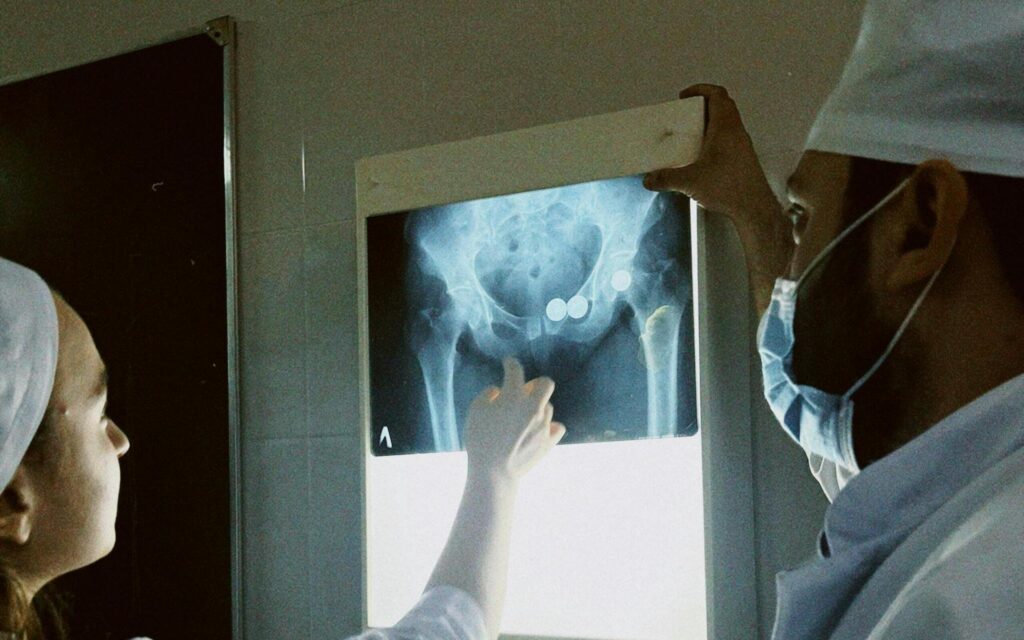
A hip fracture is a serious injury, especially common in older people. To understand hip fractures, we must first understand the anatomy of the affected area. The hip is the joint where the head of the femur (thigh bone) joins the pelvis. A hip fracture occurs when the upper part of the femur breaks, near this joint. This injury is usually very painful and disabling, limiting the ability to walk and perform daily activities. The impact on the patient’s quality of life can be considerable, especially in older people.
Symptoms of hip fractures
The symptoms of a hip fracture are usually quite obvious, although they can vary in intensity depending on the severity of the fracture and the individual’s pain tolerance. It is essential to recognize these symptoms in order to seek immediate medical attention.
Pain:
it is the most common and characteristic symptom. It is usually an intense and sharp pain in the hip or groin, which can radiate to the buttock or leg. The pain may worsen when trying to move the leg or when touching the affected area.
Inability to walk:
most people with a hip fracture cannot walk or bear weight on the affected leg. Even small movements can cause unbearable pain.
Deformity:
in some cases, the affected leg may appear shorter than the other or be rotated outwards. This is due to the misalignment of the fractured bone.
Swelling and bruising:
swelling and bruising in the hip area are common after a fracture. These symptoms may appear immediately after the injury or develop gradually over the following hours.
Hip fracture classification
Hip fractures are classified according to their location in the femur. This classification helps doctors to determine the best course of treatment. These can be:
Intracapsular fractures: they occur within the hip joint capsule, which is the membrane that surrounds the joint. They usually affect the head or neck of the femur.
Extracapsular fractures: they occur outside the joint capsule and usually affect the intertrochanteric or subtrochanteric region of the femur.
Causes of hip fractures
The main cause of hip fracture is a fall, especially in older people with bones weakened by osteoporosis. However, there are other less common causes that can also lead to this injury.
Falls: falls from standing height are the most common cause, especially in older adults. Factors such as muscle weakness, balance problems, medications that cause dizziness, and environmental hazards (loose carpets, poor lighting) can increase the risk of falls.
High-energy trauma: in younger people, hip fractures can be caused by high-energy impacts, such as traffic accidents, falls from heights, or sports injuries.
Bone weakness: osteoporosis is the main cause of bone weakness and significantly increases the risk of hip fracture. Other diseases that affect the bones, such as bone cancer or certain genetic diseases, can also weaken the bones and increase susceptibility to fractures.
A hip fracture can lead to various complications, some of which can be serious and affect long-term health. Proper treatment and rehabilitation are crucial to minimizing the risk of these complications.
Deep vein thrombosis (DVT): immobilization after a hip fracture increases the risk of DVT, which is the formation of blood clots in the deep veins of the legs. These clots can break off and travel to the lungs, causing a pulmonary embolism, a potentially life-threatening condition.
Pulmonary embolism: it is a serious complication of DVT. It occurs when a blood clot travels from the legs to the lungs, blocking blood flow.
Infections: infections at the fracture site or in other parts of the body are possible after surgery.
Joint stiffness: prolonged immobilization can cause stiffness and loss of mobility in the hip joint.
Compartment syndrome: it is a serious condition that occurs when pressure within the leg muscles increases, compressing nerves and blood vessels. It can cause permanent tissue damage.
Avascular necrosis: avascular necrosis occurs when the blood supply to the femoral head is interrupted. This can lead to bone tissue death and joint collapse.
Delayed union or pseudoarthrosis: in some cases, the fracture does not heal properly, which is known as delayed union or pseudoarthrosis.
Diagnosis of hip fracture
Diagnosing a hip fracture involves a thorough evaluation by a medical professional. Different methods are used to confirm the diagnosis and determine the severity of the injury.
Medical history and physical examination: the doctor will ask about symptoms, the circumstances of the injury, and medical history. The physical examination includes palpation of the hip and assessment of leg mobility and sensation.
X-rays: they are the main imaging test for diagnosing a hip fracture. They show the location and type of fracture, allowing the doctor to plan the appropriate treatment.
Magnetic resonance imaging (MRI) or computed tomography (CT): in some cases, an MRI or CT scan may be performed to obtain more detailed images of the hip and surrounding tissues. These tests are especially useful for evaluating complex fractures or associated injuries.
Bone scintigraphy: it can be useful for detecting occult fractures or assessing the extent of the fracture, especially in cases of suspected bone metastases.
Treatment of hip fracture
Treatment for a hip fracture is individualized according to the needs of each patient. The goal of treatment is to relieve pain, stabilize the fracture, and restore hip function.
Surgery: it is the most common treatment for hip fractures. The type of surgery depends on the type and severity of the fracture, as well as the patient’s age and health status. The options include open reduction and internal fixation (ORIF), in which the surgeon realigns the bone fragments and secures them with plates, screws, nails, or rods; arthroplasty (partial or total), where the damaged hip joint is replaced by a prosthesis. In partial hip arthroplasty (hemiarthroplasty), only the head of the femur is replaced, while in total hip arthroplasty both the head of the femur and the socket of the pelvis (acetabulum) are replaced; and minimally invasive surgery, which is used whenever possible to perform surgery with smaller incisions and less damage to surrounding tissues.
Medications: pain relievers are used to control pain after surgery. Medications may also be prescribed to prevent infections and blood clots.
Rehabilitation: it is a fundamental part of the treatment for a hip fracture. Physiotherapy helps to restore strength, mobility, and function to the hip. The rehabilitation program is tailored to the individual needs of each patient. HM Hospitales offers personalized rehabilitation programs, with physiotherapists specializing in the recovery from hip fractures.
A multidisciplinary approach, involving traumatologists, anesthesiologists, physiotherapists, rehabilitation specialists, nurses, and other professionals, is essential for comprehensive and individualized care.
Remember that this article is for informational purposes only and does not replace professional medical advice. If you suspect you have a hip fracture, consult a specialist to obtain an accurate diagnosis and an appropriate treatment plan tailored to your needs.
Our doctors
Contact and make an appointment with the professionals in this area