Stress MRI
What is a cardiac MRI?
A stress cardiac MRI (stress MRI) is an advanced test that assesses how your heart functions when under exertion or stress, similar to a traditional stress test, but with much more detailed images. It is a safe and non-invasive tool.
This test is a variant of cardiac MRI that uses a drug to simulate the effect of exercise on the heart. This allows doctors to observe how the heart responds to stress and detect potential problems that would not be apparent at rest.
What is a stress MRI used for?
A stress MRI is used to:
- Detect coronary artery disease (narrowing of the arteries that carry blood to the heart).
- Evaluate the amount of blood that reaches the heart during exertion.
- Identify areas of the heart that receive little blood (ischemia).
- Assess whether there is cardiac damage after a heart attack.
- Examine heart function in patients with chest pain or angina.
How does advanced technology work in a stress MRI?
A stress MRI combines cardiac MRI technology with the administration of a pharmacological agent:
- Powerful magnetic fields: it uses a powerful magnet to generate detailed images of the heart.
- Radiofrequency (RF) waves: radio waves are used to create images of the heart.
- Drug to simulate exercise: a drug (such as regadenoson) is administered intravenously to increase heart rate and simulate the effect of exercise.
- Gadolinium contrast: gadolinium contrast is used to better identify areas with poor blood supply.
Electrocardiogram (ECG): electrodes are placed on the chest to monitor the heartbeat during the test.
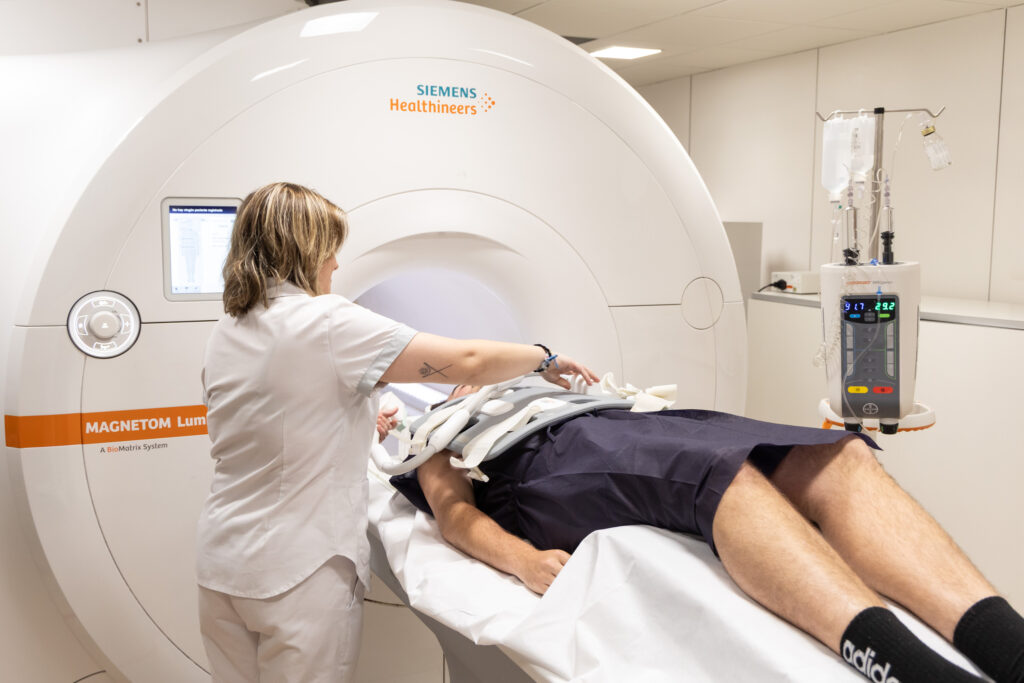
What does the procedure involve?
A stress MRI assesses how the heart responds under stress conditions, without the need for physical exercise. The phases of the procedure include:
-
Prior preparation
You should not eat for 4 to 6 hours before the procedure to avoid discomfort with the medication. It is also necessary to avoid caffeine at least 24 hours beforehand. If you have asthma, allergies, or breathing problems, inform the medical professional so they can adjust your medication if necessary.
-
During the procedure
During the procedure, electrodes will be placed on your chest to monitor your heartbeat using an electrocardiogram (ECG). Next, you will receive an intravenous drug that will accelerate your heart rate, mimicking physical exertion. While your heart responds to the drug, images of your heart will be taken at different times. A gadolinium contrast agent will be used to highlight areas of the heart with poor blood flow.
-
Upon completion
The procedure lasts between 30 and 60 minutes. After the procedure, your heart rate will return to normal, and you can resume your activities without restrictions.
Recommendations for the procedure
It is important to follow the preparation instructions carefully, such as fasting for 4 to 6 hours before the procedure and avoiding caffeine for at least 24 hours prior. Be sure to inform your doctor if you have allergies, asthma, or any breathing problems, as this may require adjustments to the procedure or medication. During the procedure, if you experience any discomfort or symptoms, please inform the medical staff immediately so they can assist you appropriately.
Are there any risks?
A stress MRI is generally safe, but it can carry some risks such as:
- Mild side effects: you may experience palpitations, a feeling of warmth, headache, nausea, or mild dizziness. These symptoms are temporary and usually disappear quickly.
- Allergic reactions to the contrast agent: although very rare, some people may have allergic reactions to the contrast agent, such as itching or a rash.
- Conditions in which the test is not recommended: a stress MRI is not suitable for people with severe asthma, uncontrolled low blood pressure, or advanced kidney disease. These conditions may worsen with the drug used for the test.
It is essential that you inform your doctor about any pre-existing conditions to ensure safety during the procedure.
To ensure your procedure runs smoothly, we ask that you arrive before the scheduled time. This will allow us to complete the necessary administrative and clinical preparation.
Before the procedure, we will give you the Informed Consent form, a document with important information that you must read and sign.
If your appointment is for an MRI, it is crucial that you inform us about the presence of pacemakers, metallic objects, prostheses (including dental prostheses), tattoos, or drug infusion devices such as insulin pumps.
Do you need to undergo this procedure?
Make an appointment