Pediatric MRI with or without anesthesia
What is a pediatric MRI with or without anesthesia?
Pediatric Magnetic Resonance Imaging (MRI) is an imaging technique that uses magnetic fields and radio waves to obtain detailed images of the inside of the body. This procedure is suitable for children of all ages, from newborns to teenagers. It is a very useful tool for diagnosing various diseases because it is a very safe test, as it does not use ionizing radiation (X-rays).
What is this diagnostic procedure for?
A pediatric MRI is used to:
- Detect problems in bones, joints, and muscles.
- Evaluate internal organs such as the heart, lungs, liver, kidneys, and spleen.
- Identify tumors, infections, and other abnormalities.
- Diagnose brain and spinal cord problems.
Benefits of advanced technology in a pediatric MRI
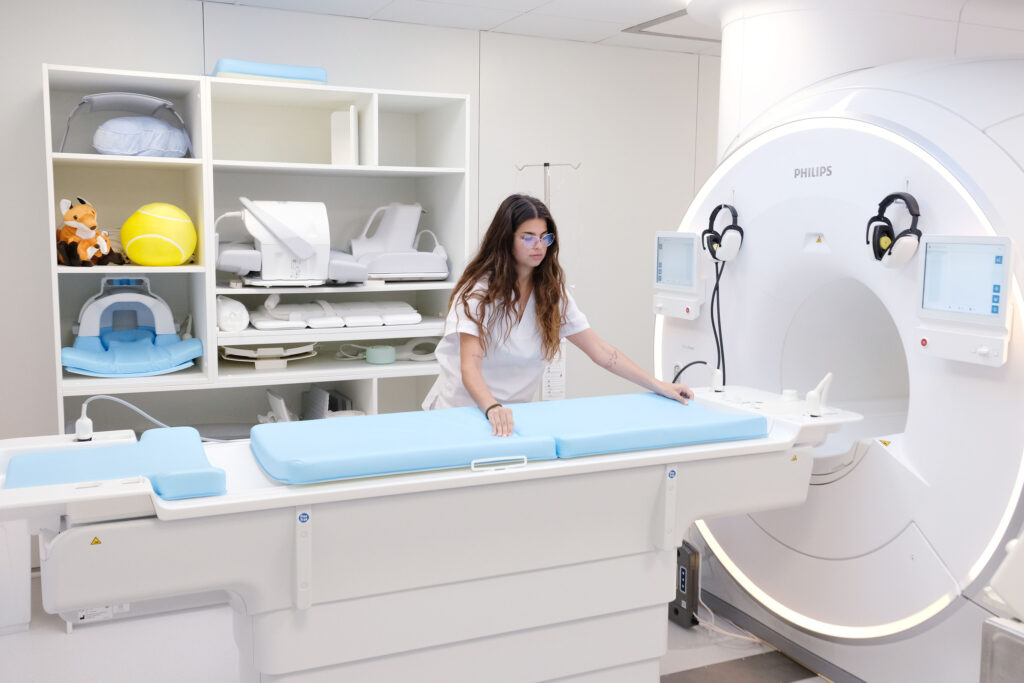
A pediatric MRI uses a powerful magnet and radio waves to create detailed images of the body. The images are taken from different angles and combined to create a three-dimensional image.
What does the procedure involve?
The pediatric MRI procedure consists of:
-
Preparation:
It is important that you explain to your child what to expect during the MRI in a simple way that they can understand. Sometimes, showing your child photos or videos of the MRI machine can help them feel more at ease.
The hospital will give you specific instructions to prepare your child for the MRI, such as the need for fasting or stopping certain medications. It is crucial that you follow these instructions carefully.
Also be sure to tell the doctor about any allergies your child has and about any pre-existing medical conditions, such as asthma, diabetes, heart problems, or seizures.
Remember that during the procedure, your child should not wear jewelry, watches, hearing aids, piercings, or other metallic objects, as these can interfere with the MRI.
Finally, you may bring an item that provides reassurance and comfort, such as their favorite toy or a blanket.
-
During the procedure:
To obtain clear images, it is essential that your child remains very still during the MRI scan. In most cases, especially in young children, this requires the use of sedation or anesthesia.
If your child needs sedation or anesthesia, the team of pediatric anesthesiologists will administer it and carefully monitor it. Before the procedure, you will be informed about the risks and benefits of sedation or anesthesia. The type of sedation can vary from mild to general anesthesia, depending on your child’s age, level of anxiety, and the duration of the procedure.
During the procedure, your child will lie on a table that will then slide into the MRI machine. Pillows, blankets, and other immobilization devices will be used to ensure that your child remains still during the scan. Special coils will be placed around the area to be examined to obtain detailed images.
It is important to note that the MRI machine makes loud noises during the scan, so your child will be given headphones or earplugs to protect their hearing. Additionally, music can be played, or a story can be told to distract your child during the procedure.
The duration of the procedure varies depending on the area of the body being evaluated, but MRI generally lasts between 30 and 60 minutes.
-
After the procedure:
If your child received sedation or anesthesia, they will be carefully monitored in the recovery room until they are fully awake and their condition is stable. Once your child is fully awake and has been evaluated by the medical team, they will be able to resume their normal activities, always following the doctor’s instructions.
The results of the MRI will be interpreted by a pediatric radiologist, who will send them to your child’s doctor. Then, their doctor will explain the findings to you and, if necessary, recommend the appropriate treatment for your child. v
Recommendations for the procedure
Your child’s safety is our top priority. The professionals at HM Hospitales are highly trained to perform pediatric MRI scans safely and effectively. In most cases, one of the parents is allowed to accompany the child during the preparation and until sedation or anesthesia begins. Don’t hesitate to ask questions and express any concerns you may have. We are here to help you and your child feel as comfortable as possible.
Are there any risks?
A pediatric MRI is a safe procedure, but there are some risks:
- Allergic reactions to the contrast (rare): in some cases, an intravenous contrast agent may be used to improve visualization of structures. There is a small risk of allergic reaction to the contrast.
- Risks associated with sedation/anesthesia: if your child receives sedation or anesthesia, there are risks associated with these procedures. These risks are minimized by continuous monitoring and the experience of the medical team.
To ensure your procedure runs smoothly, we ask that you arrive before the scheduled time. This will allow us to complete the necessary administrative and clinical preparation.
Before the procedure, we will give you the Informed Consent form, a document with important information that you must read and sign.
If your appointment is for an MRI, it is crucial that you inform us about the presence of pacemakers, metallic objects, prostheses (including dental prostheses), tattoos, or drug infusion devices such as insulin pumps.
Do you need to undergo this procedure?
Make an appointment