Multiparametric Prostate MRI (mpMRI)
What is a multiparametric prostate MRI (mpMRI)?
A multiparametric prostate MRI (mpMRI) is an advanced imaging technique used to evaluate the prostate and detect or rule out the presence of prostate cancer. Unlike a conventional MRI, an mpMRI combines different imaging sequences to obtain detailed information about the structure and function of the prostate.
What is this diagnostic procedure for?
An mpMRI is used for:
- Detecting and characterizing prostate cancer: it helps to identify suspicious areas in the prostate and determine the likelihood that they are cancerous.
- Guiding the prostate biopsy: it allows the biopsy to be directed to the most suspicious areas, increasing the accuracy of the diagnosis.
- Assessing the local extent of prostate cancer: it helps determine whether the cancer has spread beyond the prostate.
- Monitoring the response to treatment: it allows for the evaluation of treatment effectiveness in patients with prostate cancer.
- Follow-up of patients with suspected prostate cancer: in patients with elevated PSA or a suspicious digital rectal exam.
Benefits of advanced technology in an mpMRI
An mpMRI uses different imaging sequences to obtain comprehensive information about the prostate. These sequences include:
- T2-weighted images: they provide information about the anatomy of the prostate.
- Diffusion-weighted imaging (DWI): it measures the movement of water molecules in prostate tissue, which can help detect areas with high cell density, such as cancer.
Dynamic contrast-enhanced (DCE) imaging: it evaluates blood flow in the prostate, which can help identify areas with tumor growth.
What does the procedure involve?
The mpMRI procedure consists of:
-
Preparation:
In some cases, your doctor may recommend a cleansing enema before the test to obtain clearer images. In addition, it is important that you do not apply creams or ointments to the genital area on the day of the study. Fasting is generally not required, but consult your doctor to confirm any specific instructions.
-
During the procedure:
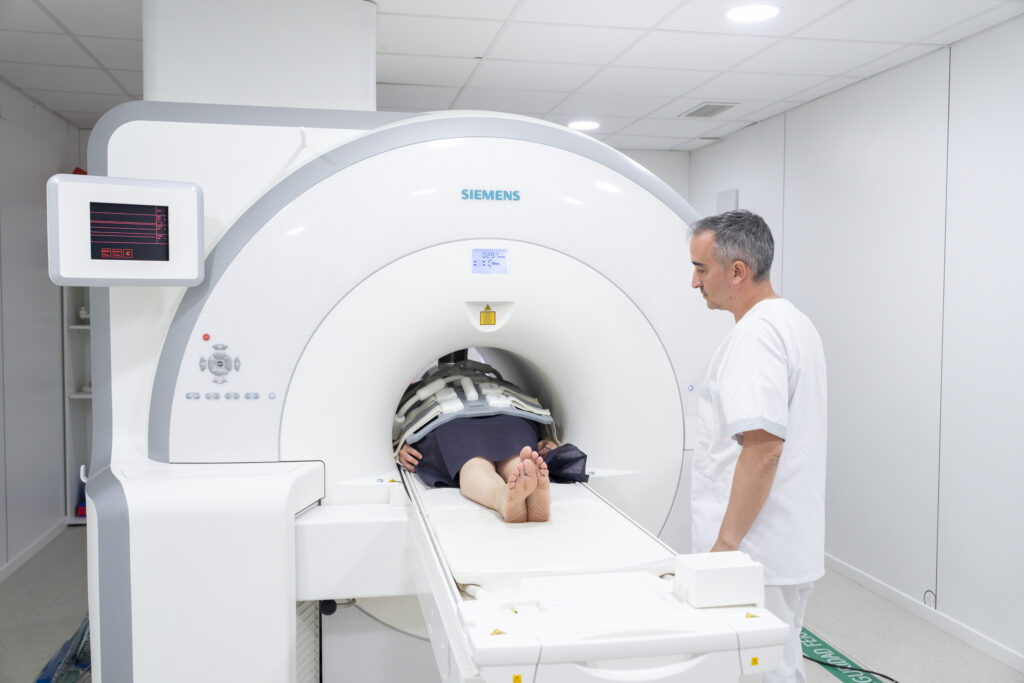
You will be asked to lie down comfortably on the MRI table. To obtain high-quality images, they will place a special coil around your pelvis. It is essential that you remain as still as possible during the scan. You will also be given an intravenous contrast agent called gadolinium to improve the visualization of the structures. The procedure lasts approximately 30–45 minutes.
-
After the procedure:
You can resume your normal activities immediately after the procedure. A radiologist specializing in urological imaging will analyze the results using the PI-RADS (Prostate Imaging Reporting and Data System) for a standardized interpretation. Then, the results will be sent to your doctor, who will explain the findings and, if necessary, recommend the appropriate treatment.
Recommendations for the procedure
- Report allergies: let us know before the procedure if you have ever had a reaction to gadolinium.
- Report kidney failure: if you have kidney problems, inform your doctor, as gadolinium could be harmful in cases of severe kidney failure.
- Inform about metal implants: inform your doctor and the MRI technician if you’re wearing any metal implants, such as pacemakers, surgical clips, prostheses, or hearing aids.
- Communicate claustrophobia: if you’re worried about feeling uncomfortable in enclosed spaces, let us know in advance so we can help you feel more at ease during the procedure.
Are there any risks?
An mpMRI is a safe procedure, but there are some risks:
- Allergic reactions to gadolinium: in rare cases, gadolinium can cause allergic reactions.
- Nephrogenic systemic fibrosis (NSF): in patients with severe kidney failure, gadolinium can cause NSF, a rare but serious illness.
To ensure your procedure runs smoothly, we ask that you arrive before the scheduled time. This will allow us to complete the necessary administrative and clinical preparation.
Before the procedure, we will give you the Informed Consent form, a document with important information that you must read and sign.
If your appointment is for an MRI, it is crucial that you inform us about the presence of pacemakers, metallic objects, prostheses (including dental prostheses), tattoos, or drug infusion devices such as insulin pumps.
Do you need to undergo this procedure?
Make an appointment