Functional MRI
What is functional magnetic resonance imaging (fMRI)?
Functional magnetic resonance imaging (fMRI) is a neuroimaging technique that uses magnetic resonance imaging (MRI) to measure brain activity by detecting changes in blood flow. It is based on the principle that neuronal activity is coupled to metabolism and cerebral blood flow. When an area of the brain is active, its oxygen consumption increases, which causes an increase in blood flow to that area. fMRI detects these changes in blood flow, allowing us to infer which areas of the brain are active during task performance or at rest.
What is this diagnostic procedure for?
Functional magnetic resonance imaging (fMRI) is used for a variety of purposes, including:
- Brain function research: it allows us to investigate how the brain works under normal conditions and in different neurological and psychiatric diseases.
- Localization of brain functions: it helps to locate the areas of the brain that are involved in different cognitive functions, such as language, memory, attention, and movement.
- Surgical planning: it can be used to plan brain surgery, identifying the areas of the brain that should be avoided to preserve important functions.
- Evaluation of neurological and psychiatric disorders: it can help diagnose and evaluate neurological and psychiatric disorders, such as Alzheimer’s disease, schizophrenia, depression, and attention deficit hyperactivity disorder (ADHD).
- Neurofeedback: it can be used to provide neurofeedback, a technique that allows people to learn to control their own brain activity.
Benefits of advanced technology in fMRI
Functional magnetic resonance imaging (fMRI) offers a number of key benefits thanks to the technology it uses:
- Non-invasive: it is a non-invasive technique that does not require surgery or the administration of radiation.
- High spatial resolution: it allows high spatial resolution images of the brain to be acquired, making it possible to precisely identify the areas of the brain that are active.
- High temporal resolution: it allows brain activity to be measured with high temporal resolution, enabling the detection of rapid changes in brain activity.
Versatility: it can be used to investigate a wide variety of brain functions and neurological and psychiatric disorders.
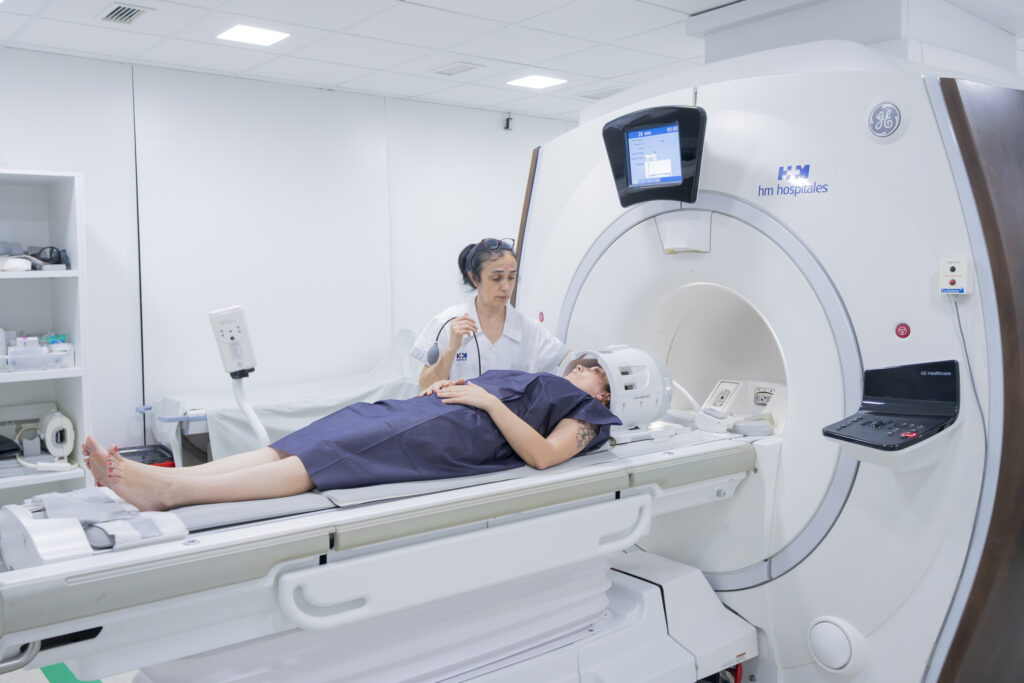
The functional magnetic resonance imaging (fMRI) procedure is generally carried out as follows:
-
Preparation:
You will be asked to remove all metal objects (jewelry, piercings, etc.) from your body. It is important to inform your doctor if you have metal implants in your body, such as pacemakers or cochlear implants. You will be asked to remain still while the images are taken.
-
During the procedure:
You will lie down on a table that slides into the MRI scanner. A coil will be placed on your head to improve image quality. Next, you will be asked to perform a specific task (for example, reading words, looking at pictures, or moving your fingers) or to remain at rest with your eyes closed. Finally, images of your brain will be taken while you perform the task or remain at rest.
-
After the procedure:
You can resume your normal activities immediately after the procedure.
Recommendations for the procedure
Remember that it is important to adhere to the following recommendations to ensure the quality of the test and your comfort:
- Inform about metal implants: it is crucial to inform your doctor if you have metal implants in your body, such as pacemakers or cochlear implants.
- Remain still: it is important that you remain still while the images are taken to avoid blurry images.
- Follow instructions: carefully follow the instructions provided by the MRI technician. Tell your doctor about any discomfort or side effects you experience after the procedure.
Are there any risks?
A functional magnetic resonance imaging (fMRI) scan is generally considered safe, but like any medical procedure, there are some minor risks to consider:
- Claustrophobia: some people may experience claustrophobia while inside the MRI scanner.
- Noise: the MRI scanner makes a loud noise that may be bothersome for some people. You will be provided with earplugs or headphones to reduce the noise.
- Allergic reactions: in rare cases, allergic reactions to the contrast agent used in some MRI scans may occur.
To ensure your procedure runs smoothly, we ask that you arrive before the scheduled time. This will allow us to complete the necessary administrative and clinical preparation.
Before the procedure, we will give you the Informed Consent form, a document with important information that you must read and sign.
If your appointment is for an MRI, it is crucial that you inform us about the presence of pacemakers, metallic objects, prostheses (including dental prostheses), tattoos, or drug infusion devices such as insulin pumps.
These diagnostic tests are very safe, but as with any medical procedure, there is still the unlikely possibility of an incident.