CT virtual bronchoscopy
What is CT virtual bronchoscopy?
CT Virtual bronchoscopy (VBCT) is a non-invasive diagnostic imaging procedure that uses computed tomography (CT) to create detailed 3D images of the airways (trachea and bronchi). These images are processed using specialized software to simulate an endoscopic view of the inside of the airways, similar to the one obtained with a traditional bronchoscopy.
What is this diagnostic procedure for?
The main uses of CT virtual bronchoscopy are:
- Airway assessment: It allows for the evaluation of the anatomy of the airways and the detection of abnormalities such as tumors, stenosis (narrowing), obstructions, foreign bodies, or malformations.
- Bronchoscopy planning: It can be used to plan a traditional bronchoscopy, identifying areas of interest and guiding the insertion of the bronchoscope.
- Evaluation of patients with contraindications for bronchoscopy: It can be used an alternative for patients who cannot undergo a traditional bronchoscopy due to health problems or contraindications.
- Monitoring of respiratory diseases: It allows the progression of respiratory diseases, such as tracheal or bronchial stenosis, to be monitored.
Benefits of advanced technology in CT virtual bronchoscopy
A CT virtual bronchoscopy scan offers a number of key benefits thanks to the technology it uses:
- Non-invasive: It is a non-invasive technique, which means it does not require the insertion of a bronchoscope into the airways.
- 3D images: It allows detailed three-dimensional images of the airways to be obtained.
- Evaluation of distal areas: It can help assess parts of the airways that are difficult to reach with a traditional bronchoscope.
Lower risk of complications: It has a lower risk of complications compared to a traditional bronchoscopy.
What does the procedure involve?
The CT virtual bronchoscopy procedure is relatively simple and is carried out as follows:
-
Preparation:
In general, no special preparation is required for this procedure. In some cases, a bronchodilator may be administered to dilate the airways.
-
During the procedure:
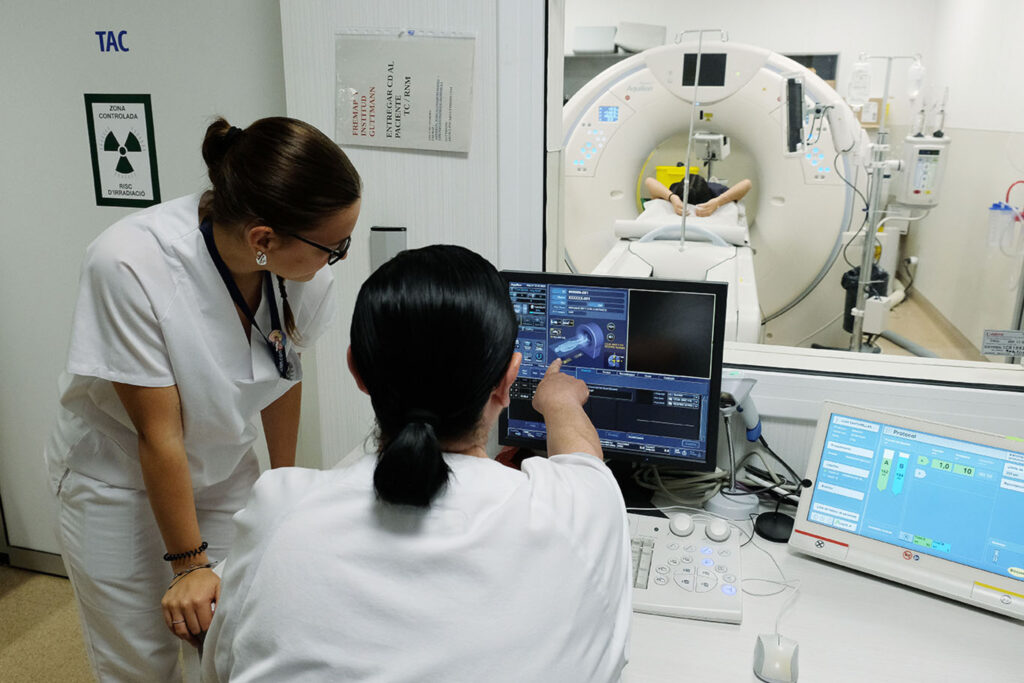
You will lie down on a table that slides into the CT scanner. They will place electrodes on your chest to monitor your heart rate. Then, you will be asked to remain still and hold your breath briefly as the images are taken. In some cases, an intravenous contrast medium may be administered to improve visualization of the blood vessels. The scan lasts approximately 15–30 minutes.
-
After the procedure:
Once the images have been acquired, you can resume your normal activities.
Recommendations for the procedure
Remember that it is important to adhere to the following recommendations to ensure the quality of the test and your comfort:
- Inform your doctor: You need to inform your doctor if you have any allergies, especially to iodine or iodinated contrast. You must also inform your doctor if you are pregnant or have kidney problems.
- Medications: Be sure to inform your doctor about any medications you are taking.
- Fasting: In general, fasting before the scan is not necessary, unless an intravenous contrast medium is to be administered.
- Clothing: Wear comfortable clothing and avoiding jewelry or metal accessories that may interfere with the images.
Are there any risks?
A CT virtual bronchoscope is generally considered safe, but like any medical procedure involving radiation and, in some cases, contrast agents, there are some minor risks to consider:
- Exposure to radiation: CT uses radiation, but the amount is generally low and considered safe. Your doctor has confirmed that the benefits outweigh the potential risks.
- Reaction to the contrast agent: Some people may experience allergic reactions to the contrast medium. If this should happen, the medical staff is prepared to handle these situations.
- Kidney problems: The contrast medium can affect kidney function, especially in patients with pre-existing kidney disease, so special precautions need to be taken if you have a history of kidney problems.
To ensure your procedure runs smoothly, we ask that you arrive before the scheduled time. This will allow us to complete the necessary administrative and clinical preparation.
Before the procedure, we will give you the Informed Consent form, a document with important information that you must read and sign.
If your appointment is for an MRI, it is crucial that you inform us about the presence of pacemakers, metallic objects, prostheses (including dental prostheses), tattoos, or drug infusion devices such as insulin pumps.
Do you need to undergo this procedure?
Make an appointment