Breast core needle biopsy (CNB)
What is a breast core needle biopsy (CNB)?
A core needle biopsy (CNB) in the breast is a procedure used to obtain a sample of breast tissue when an abnormality is suspected. It is less invasive than a surgical biopsy or vacuum-assisted biopsy. However, our radiologists will indicate which procedure is best for your particular case.
What is this diagnostic procedure for?
A core needle biopsy (CNB) of the breast is performed to:
- Diagnose breast cancer: To confirm or rule out the presence of cancer cells in breast tissue.
- Evaluate abnormalities: To investigate suspicious findings detected in mammograms or ultrasounds, such as nodules or areas of thickening.
- Obtain a sample for analysis: To allow for detailed analysis of breast tissue in the laboratory to determine the nature of the abnormality.
Benefits of the latest technology in a CNB of the breast
Ultrasound guidance in breast core needle biopsy (CNB) allows for precise localization of the lesion, ensuring that the tissue sample is obtained from the correct area, leading to a more accurate diagnosis. In addition, the radiologist can visualize the needle in real time, reducing the risk of complications and making the procedure safer. Finally, because it is guided by ultrasound, a breast core needle biopsy (CNB) is less invasive than other types of biopsy, which can result in a faster recovery with less discomfort.
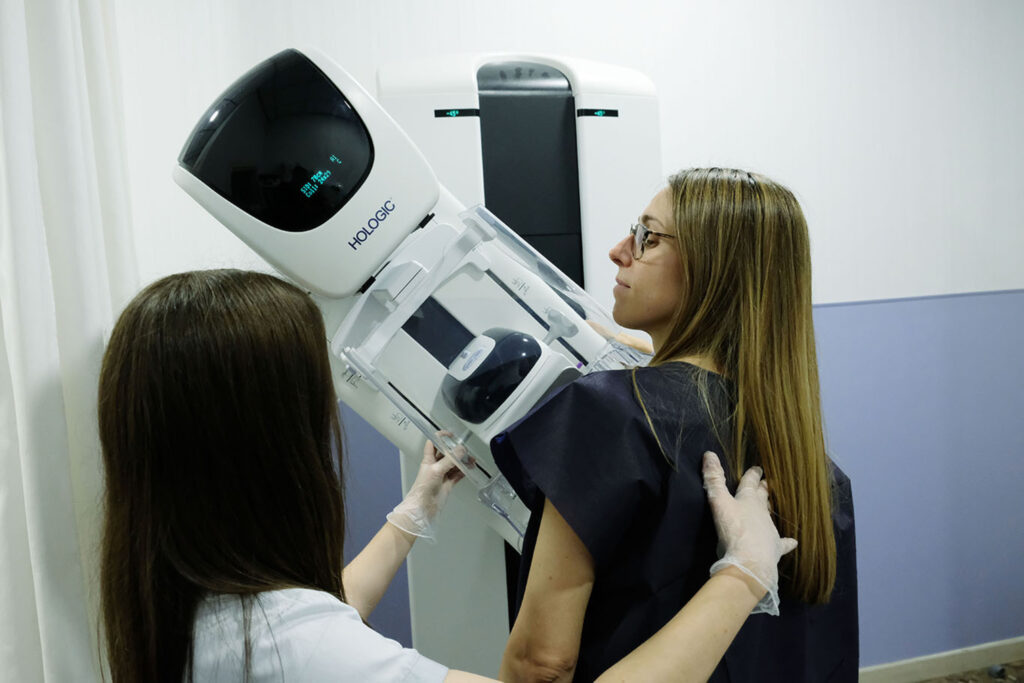
A breast CNB procedure is relatively quick and effective:
-
Preparation:
Before the procedure, the radiologist will review the images from the imaging tests where the abnormality was detected.
-
During the procedure:
It is performed in the consultation room, while you are lying on the ultrasound examination table. The skin needs to be cleaned with an antiseptic prior to the procedure. Guided by ultrasound, the lesion is located, and local anesthesia is used, allowing the procedure to be performed without pain, although you may feel some pressure. A thick needle is used and several samples of breast tissue are obtained. The samples are then sent to the pathology laboratory for analysis.
- Marker placement (optional): In some cases, a metallic marker may be placed at the site of the lesion after the procedure. The placement method will follow the same entry and path as the biopsy, using a fine needle, which will release the marker in real time into the biopsy bed. You won’t notice anything and imaging tests can still be performed without any problems. You should know that the marker will remain in the breast unless the removal of the lesion is indicated. You won’t notice it; it is extremely small in size.
-
After the procedure:
Immediately after the procedure, pressure will be applied to the area to stop any bleeding, and you will receive instructions on post-procedure care, such as applying cold compresses and subsequent compression. You may experience swelling or mild pain where the biopsy was performed, but these symptoms will disappear within a few days. You can take painkillers if necessary. Furthermore, strenuous activities and intense exertion should be avoided for the first 24–48 hours. The biopsy results will be available in a week, or sooner if they are treated as a priority.
Recommendations for the procedure
- Fasting and preparations: No fasting or special preparations are necessary before the procedure.
- Medications and allergies: It is important to let us know if you are taking any anticoagulant medication (blood thinners) or have any allergies. Also, let us know if you have any allergies to metal, especially if you’re going to have a metal marker placed.
- Pregnancy and lactation: It is safe to perform on pregnant and breastfeeding women.
- Post-procedure care: Following the procedure, compression of the area and application of ice are recommended; strenuous physical exertion should also be avoided, and signs of infection and active bleeding should be monitored. It is recommended that you go to the hospital if you notice any warning signs.
Are there any risks?
In general, it is a safe, minimally invasive, and well-tolerated procedure. As with any medical procedure, there are some risks. The main ones are:
- Bleeding or bruising: In most cases, this resolves itself in a few days or weeks. In very rare cases, there may be active bleeding that requires surgery to resolve. This risk is higher if the patient is taking anticoagulants (blood thinners) or has clotting disorders.
- Infection: It is rare, but there is a possibility of infection. Watch for redness, warmth, or fever in the area.
- Pain or discomfort: It is normal to feel discomfort after the procedure; in general, it can be controlled with mild pain relievers such as paracetamol.
- Skin changes: A small scar may remain at the puncture site, although it is hardly noticeable.
- Pneumothorax (very rare): There is an extremely low risk of a pneumothorax, which is the accumulation of air between the lung and the chest wall. This complication is exceptionally rare in a breast CNB.
To ensure your procedure runs smoothly, we ask that you arrive before the scheduled time. This will allow us to complete the necessary administrative and clinical preparation.
Before the procedure, we will give you the Informed Consent form, a document with important information that you must read and sign.
If your appointment is for an MRI, it is crucial that you inform us about the presence of pacemakers, metallic objects, prostheses (including dental prostheses), tattoos, or drug infusion devices such as insulin pumps.